


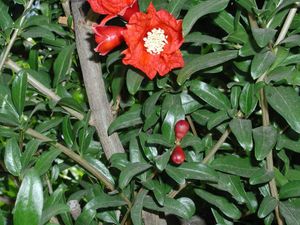
  Punica granatum. Pomegranates have enriched human history since people painted themselves red with the juice at the dawn of civilization. The photo at left shows ripening pomegranates at the Temple of Aphrodite in Cyprus. According to Greek myth the first pomegranate tree was born in the blood of Side, Orion's wife who jumped off a cliff when she was tricked into thinking she had killed her children. The fruit has symbolized death and rebirth ever since. The genus name Punica is the old name for the ancient city of Carthage. Today's world has more prosaic concerns, such as the health benefits of the juice and seeds. Pomegranate juice has more than twice the amount of antioxidants found in grape juice, green tea or red wine and reduces hardening of the arteries. The alkaloids of the pomegranate have the unique ability to paralyze tapeworms and that's enough about that topic. The bark in particular is biologically active and is antibacterial as well as antiviral. Pomegranates are arching deciduous shrubs, about 15' tall and equally wide in suitable climates. You can prune them into a tree if desired. They need hot summers for good fruit development and moderate winters for survival (to 15 degrees F). Winter chill requirements are low, less than 200 hours below 40 degrees F. A south or west wall helps the fruit ripen. Full sun, low water requirements, although regular and deep watering helps fruit development and reduces the number of thorns. Can take alkaline soil. Pomegranates are also resistant to honey fungus, good news for Northern California gardeners fighting this soil-borne disease. Do not disturb roots when planting, just place in soil and tamp down. Self-fertile, summer flowering on tips of current season's growth. Fruit ripens in fall. Plant sizes vary--read individual descriptions. Expect flowering and fruit within two years. Truly an eye-popping ornamental. Shipping charges are 35% for CA, 40% for OR, WA, AZ and NV, and 45% to rest of U.S. For orders of 2 or more plants, we can sometimes bundle them together and then reduce ship charges-please send an email describing your proposed order with zip code and we can give you exact ship costs. Sorry, no shipping to AK, HI. Orders received by Fridays at 5 pm will ship the following Monday and arrive at the latest the following Saturday. |
| ||
 | | Pomegranate 'Eve' Punica granatum. 'Eve' is a University of California introduction worthy of its name. Its red skin peels back to reveal pale pink arils that taste like black cherry candy. Plump, large fruit ripens late, into November in some climates so best in areas with moderate fall weather. A worthy newcomer to the pomegranate pantheon. This is a new crop as of September 2023, top growth about 12" tall, bushy, well-developed rootball, going dormant. Grown in 4" x 9" pots. |
| ||
| ||
 | | Pomegranate 'Desertnyi' Punica granatum 'Desertnyi.' A choice pomegranate cultivar from the Turkmenistan collection of Dr. Gregory Levin, the juice of 'Desertnyi' delivers an orange flavor unique to the world of pomegranates. The terracotta rind contrasts beautifully with the soft burgundy seeds. Grown in 4" x 9" pots, this is a new crop as of January 2023, with slender top growth about 12" tall, roots well developed. |
| ||
| ||
 | | Pomegranate 'Parfianka' Punica granatum. 'Parfianka' has won the taste tests at numerous California venues over the past few years. No wonder. Another Turkmenistan selection by Dr. Levin, the same inspired botanist who brought us 'Desertnyi,' 'Parfianka' bears at an early age and what fruit it bears! The large globes are almost like a Gravenstein apple, with streaks of amber and dark red. The arils are large, bright red, and contain soft edible seeds. The juice has a perfect balance of sweet and tart. And the plant can be pruned to stay under 8' tall. Ripens in early October and grows well in most areas. Grown in 4" x 9" pots, this is a new crop, twig-like top growth about 15" tall with well-developed rootball, beginning to leaf out as of March 2024. |
| ||
| ||
 | | Pomegranate 'Ambrosia' Punica granatum. 'Ambrosia' has the largest fruit of any pomegranate, so if you're after super-sized fruit, this variety is for you. These shiny cerise globes can be three times the size of other varieties, yet the flavor of the juice and seeds is just as intense as any other pomegranate. 'Ambrosia' is a very adaptable variety. It grows well in cool summer conditions along the Pacific coast, as well as hot summer areas through Zone 8. About 3' tall and bushy in 4 in. x 9 in. containers as of July 2021. OUT OF STOCK. |
| ||
| ||
 | | Pomegranate 'Granada' Punica granatum. 'Granada' is a bud mutation of 'Wonderful', with darker red flowers and earlier ripening, typically in August. Juice is deeply sweet without a cloying finish. Fruit, both inside and out, is a luscious burgundy color. The crown is red even when the rest of the unripe fruit is green. Hummingbirds fight over ownership of this pomegranate tree. This is a new crop as of January 2023, top growth about 15" tall, full rootball, dormant. Grown in 4" x 9" pots. |
| ||
| ||
 | | Pomegranate 'Eversweet' Punica granatum. 'Eversweet' combines nearly seedless pale pink arils with a clear, very sweet juice that will not stain your marble counters. Pink globes ripen early to midseason. Adaptable variety suitable for coastal and inland areas. Spring flower display is terrific, with large tangerine flowers worthy of any mixed border. Grown in 4" x 9" pots, plants are pruned to about 2' tall, dormant as of December 2020. OUT OF STOCK. |
| ||
| ||
 | | Pomegranate 'Sweet' Punica granatum. 'Sweet' pomegranates make smaller trees than other varieties, so this one does well in pots. Copper-red blossoms in late spring are followed by pink globes that have the sweetest juice of all. Soft arils, few seeds, similar to Eversweet. Will grow well in cool-summer locations. 3' tall plants, dormant as of January 2023. Grown in 4" x 9" grow pots. |
| ||
| ||
 | | Pomegranate 'Favorite' Punica granatum 'Favorite.' Who knew pomegranates could survive in Russia? That's the birthplace of this cultivar, which has withstood temperatures down to 10 degrees (above F) in the U.S. Many orange-red blossoms produce light red fruit, smaller than 'Wonderful' but slightly sweeter. Grown in 1 gal containers, trees are about 3' tall, bushy, dormant as of January 2023. OUT OF STOCK. |
|